Choosing a 12V DIN Rail Power Supply is not simply a matter of matching voltage and price. The correct model must support the real load, the installation environment, and future expansion. A control cabinet may look orderly, yet its power demand can change when sensors, relays, valves, and communication modules operate together.
Electrical educator Mike Holt often stresses, “Safety is not optional; it is part of every electrical decision.” That principle belongs at the center of this selection process. Check the required output current, then add practical headroom instead of sizing the supply at its limit. A 12V, 5A load may need a stronger unit if startup surges or continuous heating are present. Small details matter.
Look closely at the datasheet.
Input voltage range, efficiency, ripple, overload protection, short-circuit behavior, and operating temperature all deserve attention. A wide input range can help in unstable industrial networks. Spring-clamp terminals may simplify maintenance, while screw terminals can feel more familiar. Neither choice is automatically better. The cabinet decides.
Also examine DIN-rail compatibility, ventilation space, status indicators, and certification markings. A compact 12V DIN Rail Power Supply may fit perfectly, but poor airflow can reduce its service life. This is where selection becomes less tidy. Calculations provide confidence, but field conditions can disagree. Dust, heat, and future equipment are easy to underestimate. Leave room for them. A reliable choice is not the cheapest unit; it is the one that keeps voltage stable when the cabinet becomes busy.
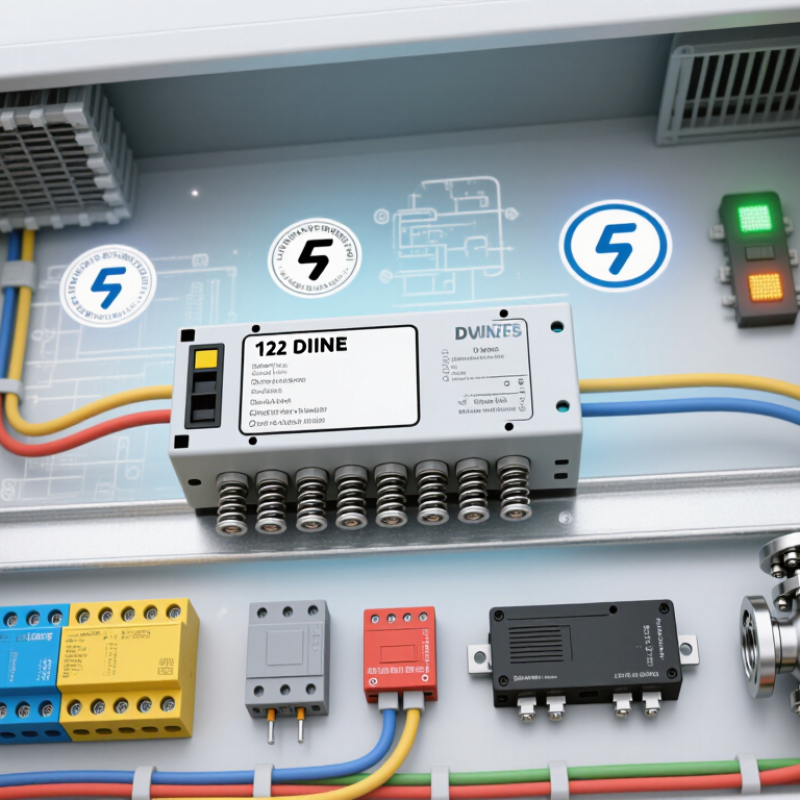
A reliable 12V DIN rail system starts with a measured load profile, not a guessed wattage. List every device, including sensors, relays, controllers, indicators, and communication modules. Record normal current and startup current separately. A compact controller may draw 0.5A continuously but several times more during boot.
Add the currents, then convert them into power: 12V × 6A equals 72W. Leave practical headroom, often 20% to 30%, for temperature, aging, and future expansion. The margin is not sacred. IEC 60204-1 emphasizes evaluating voltage drop, overcurrent protection, and abnormal operating conditions in control systems. The U.S. Department of Energy reports that motor-driven equipment consumes about 46% of global electricity, so fans, pumps, and actuators deserve special attention. Their inrush can distort an otherwise tidy calculation.
Cable length also changes the answer. For example, a 12V load drawing 4A through thin, long conductors can experience noticeable voltage loss. Measure at the device terminals, not only at the power supply. I once trusted the cabinet reading and missed a weak sensor connection. That mistake was avoidable. Check the supply’s continuous rating, peak capability, output adjustment range, and operating temperature. If the load reaches 80% continuously, reconsider the size. Keep sensitive electronics separate from noisy inductive loads when possible. Small details matter.
Choosing a 12V DIN rail power supply starts with the input voltage. Check whether the panel receives 120V AC, 230V AC, or a wider range. The International Energy Agency reported that industry used about 37% of global final energy in 2022, so efficiency and heat deserve attention. A supply with broad input tolerance can handle unstable site conditions better. Still, never assume “universal input” means unlimited protection. Confirm frequency, inrush current, and required circuit protection.
Output current is the practical test. Add the rated current of every sensor, relay, controller, and communication device. Then allow at least 20% to 30% spare capacity for startup surges, future expansion, and aging. For example, a 12V system drawing 4A should usually use a supply rated above 5A. IEC 60204-1 emphasizes reliable control-circuit power and protection, but the standard does not replace a real load calculation. That part is often rushed.
Tips: Measure actual startup current with a meter, not only the nameplate value. Check ambient temperature, ventilation, and terminal wiring. Heat reduces available output on many compact supplies. A tidy panel can still be electrically overloaded. I have seen installations pass initial testing, then trip when several valves activate together. Also verify total wattage: 12V × 5A equals 60W, but continuous operation below the limit is safer than operating at the edge. Recheck the calculation after adding each device.
Choosing a 12V DIN rail power supply starts with identifying the equipment it will operate. Check the required voltage, current, and startup surge. A regulated 12V output protects sensitive controllers, sensors, and communication devices from unstable power. For small control cabinets, a single-phase supply is often sufficient. Three-phase models suit larger systems with heavier loads.
Efficiency deserves equal attention. A supply rated above 90% wastes less energy as heat. This matters inside a narrow cabinet with limited ventilation. Calculate the expected load, then leave practical headroom. Running a 60W supply continuously at 59W may work, but it leaves little room for startup demand or aging components. Aim for a comfortable margin.
Look at the efficiency curve, not only the headline rating. Some units perform well near full load but lose efficiency at light loads. I have seen cabinets where a lightly loaded supply stayed warm all day. That suggested the specification was acceptable, but the installation was not ideal. Check operating temperature, derating data, ripple, overload protection, and terminal clearance. A fanless design can reduce maintenance, though it may need more cabinet space for cooling. Verify the input range and required safety approvals for your region. Test the supply with the real load when possible. Laboratory figures do not always match a dusty, crowded control panel.
| Power Supply Type | Typical Input | Typical 12V Output Range | Typical Efficiency | Main Advantages | Limitations | Best-Fit Applications |
|---|---|---|---|---|---|---|
| AC/DC Switched-Mode | 85–264 VAC, 47–63 Hz | 12 VDC, commonly 1–20 A | 85%–94% | High efficiency, compact size, wide AC input range, and broad availability. | May produce conducted or radiated electromagnetic interference if filtering and installation are inadequate. | PLC panels, sensors, relays, industrial controls, building automation, and general control cabinets. |
| High-Efficiency AC/DC | 100–240 VAC, 50/60 Hz | 12 VDC, commonly 2–40 A | 90%–96% | Lower heat generation, reduced operating cost, and improved performance in densely populated cabinets. | Usually costs more and may require adequate ventilation or spacing for continuous high-load operation. | Continuous-duty automation systems, high-load control panels, and installations with limited cooling. |
| Redundant AC/DC | 85–264 VAC, 47–63 Hz | 12 VDC, commonly 5–40 A per module | 88%–95% | Improves power availability through parallel modules, load sharing, and fault tolerance. | Requires compatible redundancy modules, additional cabinet space, and a higher system cost. | Critical control systems, process automation, telecommunications, and applications requiring high availability. |
| DC/DC Converter | Typically 18–36 VDC or 36–75 VDC | Regulated 12 VDC, commonly 2–20 A | 88%–96% | Converts an existing DC bus to a stable 12 VDC output and supports battery or vehicle-based systems. | Cannot operate directly from standard AC mains and must be matched to the input voltage range. | 24 VDC control systems, mobile equipment, battery systems, and isolated low-voltage DC networks. |
| Linear Regulated | Usually requires a low-voltage AC or DC source | 12 VDC, generally low current | 30%–70% | Very low output noise, simple regulation, and minimal high-frequency switching interference. | Low efficiency, significant heat dissipation, and larger heat sinks at higher load currents. | Noise-sensitive instrumentation, laboratory equipment, and low-power analog circuits. |
| Buffered or UPS-Type DC Supply | Typically 85–264 VAC with battery connection | Regulated 12 VDC during normal and backup operation | 80%–93% in normal operation | Maintains the 12 VDC load during short mains interruptions and allows controlled battery backup. | Needs battery maintenance, charging management, and sufficient enclosure space. | Security systems, communication equipment, access control, and processes requiring ride-through capability. |
Safety begins with the installation environment, not the label. Check reinforced insulation, protective earth, and SELV or PELV output design. Overvoltage, overcurrent, short-circuit, and thermal protection should recover without damaging connected equipment. IEC 61010-1 and IEC 62368-1 provide useful safety frameworks, while IEC 61000-6-2 and IEC 61000-6-4 address industrial electromagnetic compatibility.
I once focused too heavily on output current. That was a mistake. Heat, wiring space, and fault recovery mattered more.
Protection ratings need practical interpretation. An IP20 enclosure protects against fingers, but not dust or water. IEC 60529 defines these limits clearly. For dusty panels, compare the complete cabinet rating, not only the power supply. Check operating temperature, humidity, altitude, pollution degree, and derating curves. A 12V unit rated at 120W may deliver less power inside a hot, crowded enclosure.
The IECEE 2023 annual report describes a CB System covering more than 50 participating economies. This supports wider certification recognition, but it does not replace local verification.
Tips: Request the declaration of conformity, test report, and certificate number. Confirm the certificate applies to the exact model. Look for creepage distances, leakage current, and terminal temperature ratings. A certification logo alone is not proof.
My checklist still needs improvement. I now verify documents before comparing prices.
How to Choose a 12V DIN Rail Power Supply?
Confirm installation space before comparing electrical ratings. Measure the rail width, cabinet depth, ventilation gap, and terminal access. A narrow enclosure can trap heat around the supply. That matters because electrolytic capacitors age faster at elevated temperatures. Leave practical clearance above and below the unit, even when the datasheet permits less.
Wiring deserves the same attention. Use the recommended conductor size, ferrules, and a properly rated protective device. Keep 12V output wiring separate from noisy motor or relay cables. Check voltage drop at the farthest load, not only at the supply terminals. IEC 60204-1 emphasizes correct protection, identification, and conductor sizing for machine circuits. Small mistakes become expensive.
Long-term reliability needs evidence, not optimistic claims. Uptime Institute’s 2023 Annual Outage Analysis reported that 55% of significant outages caused costs exceeding $100,000. A failed control supply can create similar downtime in a smaller factory. Select a unit with overload, short-circuit, and thermal protection, then review its derating curve. The reported efficiency may look excellent at full load, but your cabinet may operate at 30%.
Do not ignore service access. Test the output under real load and record terminal temperatures during commissioning. Recheck after seasonal temperature changes. I would also challenge one common assumption: a higher wattage model is not automatically safer. Oversizing can increase cost, inrush current, and wasted cabinet space. Reliability begins with measured conditions.
Confirm installation space, wiring requirements, and long-term reliability before selecting the power supply.
Measure the available DIN rail length and allow space for end stops, terminals, ventilation, and wiring bend radius.
The chart assumes a 12V output, 5A load, 10m one-way cable run, and a 20m copper conductor loop at 20°C.
Select a unit with suitable thermal derating, overload protection, and enough continuous output capacity for the actual load.
Voltage-drop values are calculated using copper resistivity of 0.0175 Ω·mm²/m at 20°C: voltage drop = current × resistivity × loop length ÷ conductor area.
List every device, including sensors, relays, controllers, indicators, and communication modules. Record normal current and startup current separately. Add the currents together. Then use this formula: 12V × total current = power. For example, 6A requires 72W. Leave 20% to 30% spare capacity. That margin supports heat, aging, and future additions. Do not rely on guessed wattage.
Some controllers draw several times their normal current during boot. Motors, valves, pumps, and actuators may create strong inrush demand. A system drawing 4A normally may need much more briefly. Measure startup current with a suitable meter. Nameplate values can hide the surge. This part is often rushed.
Choose a continuous current rating above the calculated load. A 4A system should usually use a supply rated above 5A. Avoid continuous operation near the maximum limit. An 80% load may be a practical warning point. More capacity is not always better. Check cost, heat, and cabinet space too.
Long, thin conductors can create noticeable voltage loss. A 4A load may receive less than 12V at the terminals. Measure voltage beside the device, not only at the supply. Inspect terminal tightness and connector condition. I once trusted the cabinet reading and missed a weak sensor connection. That mistake was avoidable.
Confirm whether the panel receives 120V AC, 230V AC, or another range. Check frequency, inrush behavior, and required circuit protection. A wide input range can help with unstable site conditions. It does not provide unlimited protection. Read the installation requirements carefully. Small assumptions become expensive.
Yes, especially for controllers, sensors, and communication equipment. A regulated output helps maintain stable device voltage. Check ripple, overload protection, and output adjustment range. Separate sensitive electronics from noisy inductive loads when possible. A tidy panel can still suffer electrical noise. It happens.
Higher efficiency produces less waste heat inside the cabinet. A supply above 90% efficiency may reduce thermal stress. Check the full efficiency curve, not only the headline number. Some supplies perform poorly at light loads. A lightly loaded unit can still feel warm all day. That deserves investigation.
Check ambient temperature, ventilation, terminal clearance, and cabinet density. Heat can reduce the available output of compact supplies. Fanless designs may reduce maintenance needs. They still require space for cooling. Test the supply with the real load when possible. Laboratory figures may not match a dusty, crowded panel. Recheck the calculation after adding each device.
Choosing the right 12V DIN Rail Power Supply begins with a clear understanding of your system’s power requirements. Calculate the total load of all connected devices, including startup demand and possible future expansion. Verify that the supply accepts your available input voltage and provides sufficient output current with an appropriate safety margin. Consider whether a regulated, compact, or high-efficiency model best suits the application, especially where heat generation and energy consumption are important.
Safety and reliability are equally essential. Look for protection against overload, short circuits, overvoltage, and overheating, along with suitable certifications and protection ratings for the installation environment. Before purchasing, confirm that the unit fits the available DIN rail space and that its terminals support secure, properly sized wiring. A well-planned installation with adequate ventilation and dependable construction can improve service life, reduce maintenance, and help ensure stable 12V performance over the long term.